
For years, the biggest obstacle standing between Chinese EV makers and genuine global success hasn’t been battery chemistry, charging speed, or even brand trust. It’s been something far more mundane: maps. A car can have the slickest driver-assist stack in the world, but if it doesn’t know where the roads actually are once it leaves its home market, none of that matters. This week in Munich, XPeng showed it understands that problem better than most of its domestic rivals, and it just bought its way past it.
The Announcement
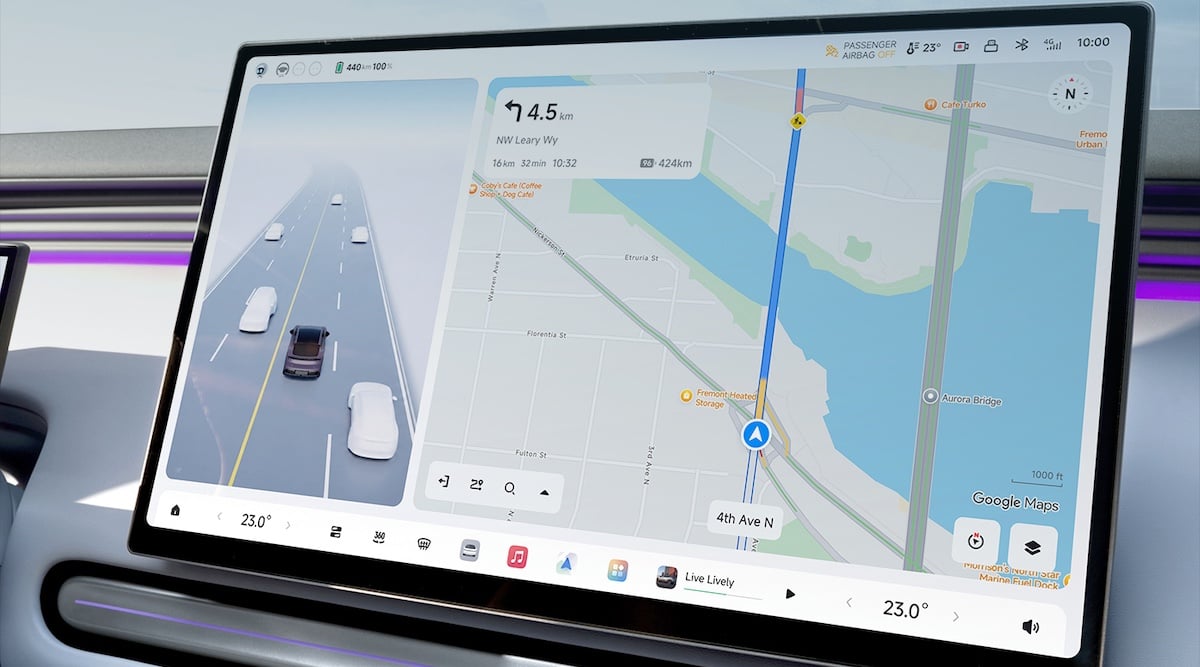
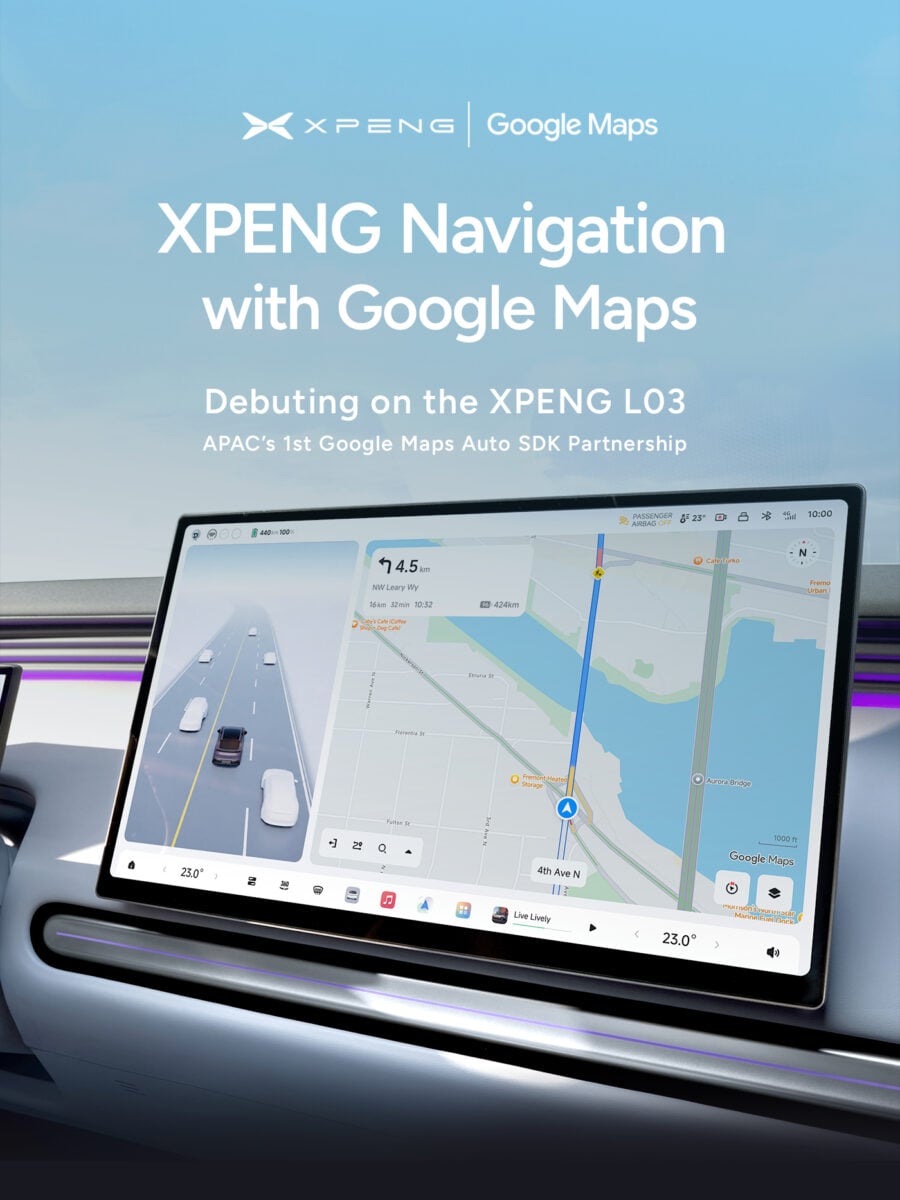
At the global launch of the new L03 SUV coupe, XPeng confirmed a partnership with Google Maps that goes well beyond slapping a familiar app icon on the infotainment screen. Using Google’s Auto SDK, XPeng has rebuilt its overseas navigation experience so that the interface, map rendering, and interactions remain fully XPeng-designed, while the routing, traffic data, place search, and EV range estimation underneath all run on Google’s infrastructure. No phone mirroring, no separate app download; it’s baked directly into the dash.
That distinction matters. Plenty of automakers let you project Google Maps from your phone. Far fewer have gone through the work of licensing the underlying SDK and threading it into their own software stack, natively, from the ground up. XPeng says the L03 is the first vehicle from any Asia-Pacific automaker to do exactly that.
Why This Is Bigger Than Navigation
The more interesting part of this deal isn’t turn-by-turn directions; it’s what happens underneath the hood of the driver-assist system. XPeng is feeding Google’s map data directly into NGP, its full-scenario intelligent driving system now running on VLA 2.0, as well as XPILOT ASSIST, the brand’s more foundational assistance suite.
That’s the real unlock. Advanced driver-assistance systems live or die on the quality of the map data behind them: lane geometry, road rules, real-time conditions. Building that infrastructure market by market, country by country, is slow, expensive, and exactly the kind of unglamorous groundwork that has quietly strangled other Chinese automakers’ international ADAS ambitions. Instead of spending years mapping 64 countries one at a time, XPeng effectively rented Google’s decade of accumulated mapping data and pointed it straight at its assisted-driving stack. It’s a shortcut, and a smart one.
Jorgen Behrens, VP/GM of Google Maps Automotive, framed the deal in terms of scale: Google Maps sees billions of monthly users, and now that reach extends directly into XPeng’s cockpit. For XPeng, the calculation runs the other way: global map credibility, purchased rather than built from scratch.
The L03 Itself Isn’t Small Potatoes Either
This isn’t a quiet software update tacked onto an existing model. The L03 is XPeng’s most aggressive global push yet, launching simultaneously across 64 countries and regions, with European pricing starting around €35,000 and an EREV (extended-range EV) variant on offer alongside the pure electric version. Under the skin, it runs XPeng’s XOS 6 platform, and higher trims pack XPeng’s own Turing AI chips pushing serious compute for the VLA 2.0 driving system.
Positioned as a stylish SUV coupe aimed at younger buyers, the L03 is clearly meant to be a volume play, not a halo car. And volume plays are exactly where mapping and ADAS reliability start to matter most: you can’t sell tens of thousands of units across dozens of unfamiliar markets on unproven navigation software.
The Takeaway
Chinese EV makers have spent the last few years proving they can out-engineer legacy automakers on hardware, software, and price. What’s been missing is the boring, invisible infrastructure that makes a car feel trustworthy the moment it crosses a border. XPeng’s Google Maps deal is a quiet admission that some of that infrastructure isn’t worth building alone, and a sign that the company is willing to partner strategically rather than reinvent every wheel to win overseas.
It’s not a flashy headline. But for anyone tracking which Chinese automakers are actually ready for a global stage, versus which ones are simply announcing one, this is the kind of unglamorous, load-bearing decision that tends to separate the two.
The Google Maps integration is currently confirmed for overseas markets, excluding the Commonwealth of Independent States, with the L03 first in line before it rolls out across the rest of XPeng’s lineup.